Friday, 19 April 2024

ADVERTISEMENT

A fluid arena

The 1990s was a watershed era. A new entity called non-government organisation emerged at the grassroots level which redefined the nature of non-party political formations
Social as political.

Social as political.Sourced by the Telegraph

Hilal Ahmed
Published 18.04.24, 07:18 AM

As a young journalist working for a weekly newspaper in the early 1990s, I did an interview with Harkishan Singh Surjeet, the leader of the Communist Party of India (Marxist) and one of the most influential politicians at that time. I was curious to know his views on the future of progressive politics in the Hindi-speaking states where the Bharatiya Janata Party had already become a powerful political entity. Surjeet did not give a politically-correct reply. Accepting the ever-declining influence of the Left parties, he made a very insightful comment. He said that the Left parties and progressive groups were not sufficiently involved in social action activities at the grassroots level. As a result, the politics of protests and demonstrations, which were intrinsic to progressive politics, had eventually become episodic and unconvincing. According to Surjeet, this would have a direct impact on electoral mobilisation as well.

Surjeet’s critical comments have a wider relevance. The political parties still organise protests, demonstrations, rallies, road shows and yatras to assert themselves in public life. But these forms of collective action are now reduced entirely to electoral politics. In fact, a new form of counter-protest has emerged in recent years, where protests are organised against an ongoing protest. The demonstrations led by a section of pro-BJP groups in support of the Citizenship (Amendment) Act, 2019 are a good example in this regard. The idea of protest as a political technique in this sense has somehow become contested.

ADVERTISEMENT

It is important to remember that the political parties did not emerge entirely as electoral entities in colonial India. The British State, no doubt, expressed its commitment to responsive government and fair representation of communities/interest groups. Yet, the expected role of a political association was to advise the colonial State to function smoothly. The initial growth of the Congress, the Muslim League and the Hindu Mahasabha demonstrates this trajectory. The rise of nationalism in the first decade of the 20th century encouraged political groups to invent new political techniques to assert their demands. At the same time, there was a need to have broad-based mass mobilisation. In this context, public protest as a form of political action came into existence.

It was M.K. Gandhi who introduced the idea of satyagraha to make the notion of protest more meaningful and effective. Protest in the Gandhian schema had at least three dimensions: purpose; commitment; and effect. Gandhi made it clear that protest should have a purpose. This means that protest as satyagraha must be carefully organised to assert a thoughtful demand. According to Gandhi, “Satyagraha is never adopted abruptly and never till all other and milder methods have been tried” (Young India, January 14, 1926). Gandhi was equally concerned about commitment-building. He asked an individual satyagrahi to rethink his/her association with the larger cause. Finally, Gandhi was keen on building public opinion before organising any big protest. That was one of the reasons why Gandhian protests were deeply linked to his social action. The recent work of the Gandhian scholar, Dhanajay Rai, on Gandhi’s ‘Constructive Programme’ is very relevant to understanding Gandhi’s redefinition of protest politics.

ADVERTISEMENT

The Gandhian influence on forms of collective action continued to survive after Independence. Even though electoral politics emerged as the defining future of the political system in India, political parties did not give up on the idea of social action. In a way, electoral politics was seen merely as a tool to achieve a wider social transformation from a variety of ideological vantage points. This led to the proliferation of a number of social initiatives. Cultural organisations like the Indian People’s Theatre Association and Gandhian movements like bhoodaan functioned as a bridge between political processes and the people at the grassroots. The spread of the Rashtriya Swayamsevak Sangh and the Jamaat-e-Islami in the 1950s and the formation of the Vishwa Hindu Parishad in the later years should also be seen in this political context.

Two crucial developments in the 1970s were very significant in the postcolonial story of protest politics. On the one hand, a new kind of people’s movement emerged in the country. The movements against displacements, Dalit and Adivasi struggles for dignity and equality, and the women’s movement against various forms of patriarchal dominance redefined the nature of protest politics in a significant way. Around the same time, the anti-Emergency protest paved the way for a number of civil liberty organisations to emerge. Jayaprakash Narayan’s famous movement against Indira Gandhi’s authoritarian policies in this sense was a crucial reference point to what the political scientist, Rajni Kothari, calls the “non-party political formations”.

These movements highlighted the fact that the social arena should always be recognised as the site for political negotiations and dialogues. The emphasis on the ‘social’ gave them a tremendous capacity to influence mainstream party politics. The politics of protest also found a new meaning in this phase. Protest became a technique to demonstrate the stated objectives and larger goals of the movement in such a manner that the social segment concerned could adequately be sensitised for mobilisation purposes; at the same time, a direct and clear message could be sent to the political class.

It is worth noting that the VHP began its Ram temple agitation in the early 1980s. The aim was to mobilise Hindus for the construction of a temple on the site of the Babri masjid in Ayodhya to mark the birthplace of Rama. In response to this agitation, a non-party Muslim coalition, the Babri Masjid Movement Coordination Committee, was also formed in 1986. These formations were entirely religion-centric. Unlike other people’s movements, they did not have any clear agenda for wider social transformation. Nevertheless, the spread of these organisations created the possibility for a new form of protest politics based on communal considerations.

The 1990s was a watershed era. A new entity called non-government organisation emerged at the grassroots level which redefined the nature of non-party political formations. The NGOs did not replace the people’s movements; rather, they created and shaped an issue-based and funding-driven discourse in which all the stakeholders had to operate. The outcome of this process was obvious. The people’s movements became ‘sector-oriented’ and somehow deviated from the agenda of wider
social change.

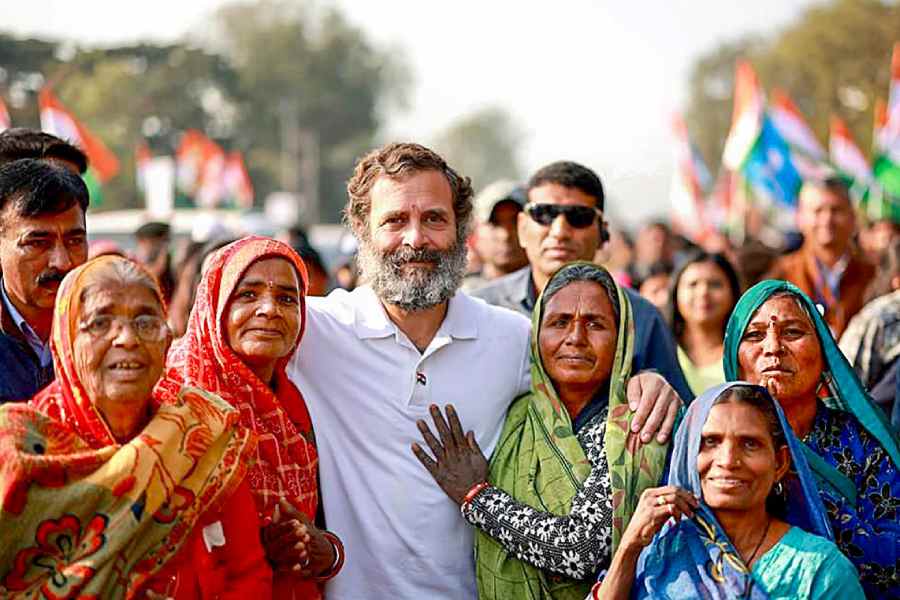
This process had two direct implications. One, the people’s movements lost their mobilisational capabilities. As a result, their protest politics got converted into issue-based demonstrations. Second, this deviation also helped organisations like the VHP to occupy the social arena completely. It is now easier for them to nurture the Hindutva-centric discourse of identity at the grassroots level without facing any ideological resistance. The dominance of Hindutva politics at the social level has helped the BJP communicate directly with various segments of society. The non-BJP parties do not have that advantage. Rahul Gandhi perhaps is the only Opposition leader who recognises the value of the social arena. His two Bharat Jodo Yatras must be seen as a new beginning. It will be interesting to observe how the outcome of the 2024 election will shape the contours of protest politics in the future.

Hilal Ahmed is Associate Professor, CSDS, New Delhi

Follow us on:
EdugraphWorkshops_LaunchCreative_10042024_TTAP
ADVERTISEMENT
❎

Wednesday, 17 April 2024

PROMISES AND PERILS OF AI BY HARVARD THINKING PODCAST

PROMISES AND PERILS OF AI BY HARVARD THINKING PODCAST


 “So, with AI, there are going to be consequences, and some of them will be good surprises, and others of them will be bad surprises. What is it that we want to do in the way of achieving a good society? And where does the technology help us or hurt us?

Until recently, the capabilities of artificial intelligence have fallen short of human imagination. It's now catching up, and it raises the question, how do we develop these technologies ethically? Thank you.

Welcome to Harvard Thinking, a podcast where the life of the mind meets everyday life. Today, we're joined by...

Martin Wattenberg. I'm a computer scientist and a professor here at Harvard.

Martin is also part of Embedded Ethics, a Harvard initiative to bring philosophers into computer science classrooms. Then...

Susan Murphy. I'm a professor also here at Harvard. I'm in statistics and the computer science department.

She's also a faculty member at the Kempner Institute for the Study of Natural and Artificial Intelligence. She works at the intersection of AI and health. And finally...

Sheila Jasanoff, and I work at the Kennedy School of Government.

A pioneer in the field, she's done a lot of work in science[…]”


From Harvard Thinking: The promise and peril of AI, 10 Apr 2024

https://podcasts.apple.com/in/podcast/harvard-thinking/id1727411132?i=1000652041819

This material may be protected by copyright.

Tuesday, 16 April 2024


LACK OF STATE CAPACITY

Is india achieving its potential? In the year to the third quarter of 2023, the country grew at a blistering rate of 8.4%. Over the next half-decade it is expected to expand at 6.5% a year, which would make it the world’s fastest-growing big economy. So far, so good. The problem, as critics point out, is that China, Japan and South Korea all expanded at 10% or so a year during their periods of rapid growth. Part of the reason for India’s less impressive figures is a slowdown in globalisation. But a new book by Karthik Muralidharan of the University of California, San Diego, called “Accelerating India’s Development”, argues that the crucial barrier to faster development is a lack of “state capacity”.


MORE EXPECTATIONS THAN CAPACITY

Mr Muralidharan describes this concept as the “effectiveness” of government. Throwing money at a state lacking capacity is like adding fuel to a car near a breakdown: it won’t get you very far. Currently, the Indian state succeeds when on “mission mode”, achieving clearly defined goals. In April it should pull off the largest democratic exercise in history, as voters pick a prime minister. At the same time, it struggles with mundane, everyday aspects of governance, such as education and health. Three in five rural children in the fifth year of school cannot read at a second-year level—and in the past five years the failure rate has only worsened.


Part of the issue is the precociousness of Indian democracy. The franchise became universal in 1950, when the country was mostly impoverished. Citizens demanded that the state met their basic needs well before it had the money or capacity to do so. India launched its food-security programme in the 1960s, for instance, when it was a fifteenth as rich per person as America was when it launched its own such programme in the 1930s. This set a pattern: the Indian state does a lot, but little well.


In his 800-page tome, Mr Muralidharan lays out fixes. The book is crammed with details about how the Indian system works and could be improved. Three ideas stand out. They concern how the state should manage people, use technology and improve its federal system. And they hold lessons for other governments.


PROBLEMS OF GOVERNENCE

VACANT POSTS

Since 2002, when Mr Muralidharan was a graduate student, he has been conducting surveys on absentee rates. It turns out that teachers skip school perhaps as often as pupils: they are absent 20-30% of the time. The problem is not pay. In 2017 a study by Rohini Pande of Yale University found that across 33 countries, India offered the second-highest wage premium to public-sector employees. Rather, the problem appears to be governance. School supervisory positions have ultra-high vacancy rates of 20-40%. Mr Muralidharan calculates that filling such roles would be ten times more cost-effective than hiring more teachers.


FREQUENT TRANSFERS

Such problems reflect a strange approach to civil-service management. About 1m Indians apply each year for about 1,000 slots, making it one of the most selective bureaucracies in history. Yet India has just 16 public employees per 1,000 people, one of the lowest ratios in the world. Indian officials also hop from position to position across various different tiers of government, moving every 15 months on average. As a recent retiree notes, this means that they have far too little time to develop proper expertise in any one area. Therefore problems go unresolved.


POOR DATA

Better data would help. It should not take an academic survey to ascertain rates of teacher absenteeism. Official numbers on educational outcomes paint a far rosier picture than those collected by independent organisations. Schools and low-level bureaucrats have incentives to cheat. As such, Mr Muralidharan suggests digital data collection, audits and stiffer accountability.

CORRUPTION

A running theme throughout the book is the need to pay attention to India’s federal structure. The country has 28 hugely diverse states, 15 of which are big enough to be in the top fifth of the world’s countries by population. Historically, Indian politicians have fallen prey to cycles of corruption in which companies bribe leaders in exchange for favours, with leaders then using the money to fund expensive campaigns that involve, in effect, bribing voters. In some states, this cycle is starting to break down. Campaigns promising to get stuff done are precisely what propelled Narendra Modi, India’s prime minister, to fame when he ran the state of Gujarat.


POOR LOCAL GOVERNMENT AND LESS DECENTRALIZATION

Progress in the “third tier” of government, which is made up of villages, towns and cities, has been less impressive, however. Deng Xiaoping, China’s leader from 1978 to 1989, introduced reforms that rewarded local officials for their economic performance. India could use something similar, especially if states granted their local authorities more resources and power. Of the 18 similar countries looked at by Mr Muralidharan, India was the least decentralised when it came to fiscal affairs. Just 3% of state spending happens at a local level, compared with 51% in China. In 2000 three Indian states—Bihar, Madhya Pradesh and Uttar Pradesh—were split in two. So was Andhra Pradesh in 2014. All four splits have led to faster economic growth.


There is much else in Mr Muralidharan’s book. But changes to personnel, data and federalism would together represent the beginnings of a reform package that could do wonders for India’s governance, and therefore its growth. Indeed, the sheer variation in performance across India’s cities and states demonstrates the potential benefits. Karnataka, a large and reasonably well-run state, is six times richer per person than Bihar, the country’s poorest state—making India one of the world’s most geographically unequal countries. Internal migration is relatively rare, which means that for incomes to grow faster, poor states will have to get their act together. The changes outlined by Mr Muralidharan will be tough to enact, but not impossible. And if some states make the leap, they may inspire others to follow their example.

Saturday, 13 April 2024

CHINESE DEMOGRAPHY LESSONS FOR INDIA

China’s high-stakes struggle to defy demographic disaster
https://www.economist.com/china/2024/04/09/chinas-high-stakes-struggle-to-defy-demographic-disaster
from The Economist

In firm control

The Telegraph India Online
12.4.24

In firm control

The power of governments, compared to what the big tech firms possess, is trivial. We are, in many ways, owned by the Mark Zuckerbergs and Jeff Bezoses of the world


We are witnessing a discernible decline in the strength of democracy as a social and political system not only in India but also the world over. What is surprising is the fact that the erosion is not the effect of external shocks, like military coups or foreign aggressions, but rather through the damages wrought by elected governments. The cancer lies within. It is true that democratic systems are not perfectly defined, the observed systems vary from country to country, and they change in different ways over time. However, there is an ensemble of features that is common to most versions. None of the features taken in isolation defines democracy, but their collective presence provides the essential structure.


The most basic among these is the ability of citizens to exercise some sort of franchise by which they can choose their government and, more so, to change governments by voting politicians out of power. The second feature ensures that those elected to rule the country do not misuse the exercise of power. This is guaranteed through constitutionally-granted checks and balances that include political rights, civil liberties, and a set of neutral institutions that can restrict governmental arbitrariness, like courts of law, or other institutions like a free media, or, as in some countries, a neutral Election Commission. Above all, the ability to voice opinions that are critical of the government is central to the set of freedoms and rights that a citizen enjoys.

Each of these features is being compromised. Elections are hardly fair and free, with false propaganda, ballot-box tampering, and big-money campaigns making the individual’s vote worthless. Social media, along with the commercial electronic media, has made us tribal to the extent that we seek constant validation and comfort by being with people like us — people who think, behave and have lifestyles similar to ours. Hence, societies have become aggressively polarised. Social media gives one the courage of numbers and the safety of crowds. Each tribe wishes to have the other extinguished decisively and rapidly. The tribe in power is usually the groups from the far-Right of the political spectrum. A longish second half of the twentieth century had seen the rise of a liberal democratic polity, which also contributed to its own decay.

Now, in the twenty-first century, the far-Right is the more radical voice of change that gains support. The first act of governance, when these tribes enter the throne room of power, is to begin stifling the voices of dissent. Gradually, rights are curbed and civil liberties trodden over. All these can be done without altering the rulebook. It is the de facto world that changes sharply. Neutral institutions are purchased or threatened into servility. All these changes take place without much fanfare or explicit changes in laws and regulations. Existing rules are simply disregarded and flouted. Every feature that defines the broad contours of democracy gets distorted. The long arm of the State begins to crawl and extend to all and sundry — citizens, institutions, political Opposition, internal critics. This is necessary to ensure that any dissent or organised opposition beyond the ballot box is made dangerous and well-nigh impossible.

In the world of fake news and falsities, the charisma that authoritarian rulers enjoy is actually ephemeral. Big business rules the world of illiberal democracies, not the authoritarian leaders who hog the headlines. The de facto transitions in the features of democracy are linked to the vast changes that are happening in the structure of capitalism. The world of manufacturing and factory technologies is far less important now compared to the world of ideas, knowledge, and algorithms — the nebulous clouds of cyberspace. This is the world of high technology beyond the information and communications revolution. The explosion in data has given these large companies unprecedented power to control, manipulate, and influence human behaviour as never before. The power of governments, compared to what the big tech firms possess, is trivial. We are, in many ways, owned by the Mark Zuckerbergs and Jeff Bezoses of the world.

Industrial capitalism is giving way to a new type of feudalism. The Industrial Revolution emerged from the world of European feudalism where land was the primary asset and rent extracted from it was the principal source of income. This gave way to machines and manufactured capital as the main assets from which income flowed. Profits became the main source of income and the working class remained stable and with a reasonably secure wage. The new world emerging has data and information as capital and the income earned is a rent and not profit as normally understood. Some scholars have begun to refer to this as cloud rent in the age of the internet. When we post on Facebook, we are not working for Zuckerberg and he pays us no wages, but our post enhances his capital — data. This is not the wage labour to capital nexus of capitalism. Firms like Google, Meta, Apple or Amazon do not have workers in the sense that twentieth-century firms had. In those days, large firms used to have payroll figures that were 80%-85% of their top-line earnings. The big techs of today spend something like 1%-2% as wages.

This trend has a number of implications. The unprecedented concentration of wealth and income is not distributed through taxes and subsidies. The wealth is not used in widening the capital base or the sources of livelihoods. The old-style labour force with unions and collectives has given way to informal work and the unorganised gig economy. The tech giants of the world have way more power than any government in their ability to control mass behaviour. Indeed, despite the far-Right’s usual ideological arsenal of nationalist identity, the final validator of one’s identity remains the tech companies in cyberspace. Without Google or Apple confirming our identities, we are half a human being. If there is any long-drawn struggle in the transition to this new form of economic feudalism, it will be between the big tech companies and governments.

These captains of industry, to retain their control over wealth, need to create social polarisation and as well as the ability to reproduce the schism over time. The political pawns of these companies appear as the illusory political masters of the new order. They are mere actors strutting on stage, their dance choreographed from behind the scenes. It is a kind of feudalism because the source of earnings is a form of economic rent and the formal features of freedom associated with capitalism are no longer relevant. There is a tiny elite — the super-rich — who control governments, control our beliefs, influence our behaviour, and supply us with a stream of illusions. Religion and politics merge. Control is the key, and dissent has dangerous consequences. As far as the proverbial democracy’s man-on-the-street is concerned, there is a variety of goods — real and virtual — to choose from. He is socially disconnected, rather awkward in the real world, completely helpless without smart devices, and awestruck by the spectacular show of intelligent machines. All of us are on a high-tech ride to a distant past.

Anup Sinha is former Professor of Economics, IIM Calcutta


Thursday, 11 April 2024

JAFFRELOT ON MODI


CHRISTOFF JAFFRELOT ON MODI


https://thediplomat.com/2024/04/christophe-jaffrelot-on-what-makes-brand-modi-successful/

Monday, 1 April 2024

DEMOCRACY AND TYRANNY BY ACADEMY OF IDEAS

The following is a transcript of this video.

“Remember Democracy never lasts long. It soon wastes exhausts and [destroys] itself. . .It is in vain to Say that Democracy is … less proud, less selfish, less ambitious or less avaricious than Aristocracy or Monarchy. It is not true in Fact and no where appears in history. Those Passions are the same in all Men under all forms of Simple Government, and when unchecked, produce the same Effects of Fraud Violence and Cruelty.”   

Letter from John Adams to John Taylor, December 1814

In every age there is a set of beliefs that are elevated to a sacred status and questioning them is deemed heretical. For centuries it was the dogmas of Christianity that possessed this status, today it is the dogma of the democratic state. Democracy, as currently practiced, is the greatest form of government and anyone who denies this commits blasphemy – or so we are taught. But just as much of the Christian dogma was a veil to protect the power of the Church, the same can be said about democracy. Democracy, with its political campaigns, elections, and the illusion of rule by the people, is a veil behind which politicians and bureaucrats parasitically enrich themselves while imposing their corrupt vision of society on the rest of us. In this video we explore some of the fatal flaws of modern democracy and explain how instead of promoting social flourishing, it has given rise to a form of soft totalitarianism. 

“Conceived as the foundation of liberty, modern democracy paves the way for tyranny. Born for the purpose of standing as a bulwark against Power, it ends by providing Power with the finest soil it has ever had in which to spread itself over the social field.”  

Bertrand de Jouvenel, On Power

There are many institutions that are necessary for a free and prosperous society; these include free markets, the division of labour, a rule of law that promotes order and trust, strong families, sound money, a school system that educates instead of indoctrinates, and a robust media that pursues the truth instead of spreading propaganda. If a democracy preserves these institutions, then one can claim that it is a form of political organization conducive to social harmony. But if a democracy continually produces governments that destroy these institutions, then the value of democracy must be questioned. Across the globe, the governments of most democracies are doing the latter – from the family unit, to schooling, the media, free markets, sound money, or the rule of law, politicians and bureaucrats are actively destroying, or at least severely corrupting, these institutions. Why is this? What are the flaws of modern-day democracies that are leading it to manifest such corrupt governments?  

To answer this question, we must distinguish between two types of democracy: direct democracy and indirect democracy. A direct democracy involves citizens casting votes on specific issues, usually by means of a referendum. In a direct democracy majority rules. Whether one views this form of political organization in a positive or negative light will usually depend on if one belongs to the majority or minority. Those in the majority tend to believe that direct democracy is a good system as it leads to the satisfaction of their wants, while those in the minority often feel that direct democracy is nothing more than a tyranny of the masses. “Democracy is two wolves and a lamb voting on what they are going to have for lunch,” Benjamin Franklin famously remarked. While the 19th century British politician Auberon Herbert had this to say concerning the morality of a direct democracy: 

“Five men are in a room. Because three men take one view and two another, have the three men any moral right to enforce their view on the other two men? What magical power comes over the three men that because they are one more in number than the two men, therefore they suddenly become possessors of the minds and bodies of these others? As long as they were two to two, so long we supposed each man remained master of his own mind and body; but from the moment that another man, acting Heaven only knows from what motives, has joined himself to one party or the other, that party has become straightaway possessed of the souls and bodies of the other party. Was there ever such a degrading and indefensible superstition?” 

Auberon Herbert, The Right and Wrong of Compulsion by the State

A tyranny of the masses, however, is not the most serious threat facing the West as we live in indirect democracies which render most people politically impotent and the power of the masses relatively negligible. In an indirect, or representational democracy, we vote for politicians who are then, in theory, supposed to represent our interests. But how representational democracy should work in theory, is not how it works in practice. In almost all democratic countries a small number of political candidates are preselected by a handful of political parties that monopolize each country’s political system and from these candidates we vote for the ones we prefer, or at least dislike the least. Once elected, far from being forced to represent the interests of the majority, politicians can, and frequently do, serve their own interests. Or as Frank Karsten and Karel Beckman note in their book Beyond Democracy: 

“It is not ‘the will of the people’, but the will of politicians – prompted by groups of professional lobbyists, interest groups and activists – that reigns in a democracy.”  

Frank Karsten and Karel Beckman, Beyond Democracy

Many will counter that a benefit of an indirect democracy is that we can vote out the corrupt politicians who fail to serve us. The problem, however, is that modern democracies rarely produce honest and ethical political candidates. Each time one corrupt politician is voted out of office, he or she is replaced by another corrupt politician who merely serves different special interest groups. Furthermore, nation states have grown so large that most of the state actors who rule over us and implement the policies that affect us on a day-to-day basis are bureaucrats who are not subject to popular elections.  

And herein lies perhaps the most serious flaw of modern democracies – the democratic process seems incapable of preventing the worst from rising to the top in government. There are several factors that can account for this: Firstly, there is the corrupting nature of power. 

“Unlimited power in the hands of limited people always leads to cruelty.”  

Aleksandr Solzhenitsyn, The Gulag Archipelago

Or as Mikhail Bakunin wrote: 

“However democratic may be their feelings and their intentions, once [politicians] achieve the elevation of office they can only view society in the same ways a schoolmaster views his pupils, and between pupils and masters equality cannot exist. On one side there is the feeling of a superiority that is inevitably provoked by a position of superiority; on the other side, there is a sense of inferiority which follows from the superiority of the teacher. . . Who-ever talks of political power talks of domination; but where domination exists there is inevitably a somewhat large section of society that is dominated. . .This is the eternal history of political power. . .”  

Mikhail Bakunin, The Illusion of Universal Suffrage

Another factor that can account for the moral corruption of politicians is that like a moth to flame, the most ruthless and power-hungry among us are attracted to state power. Those who enter the game of politics are often the very individuals who we least want to rule over us, or as Frank Herbert wrote: 

“All governments suffer a recurring problem: Power attracts pathological personalities. It is not that power corrupts but that it is magnetic to the corruptible.”  

Frank Herbert, Chapterhouse: Dune

Another explanation for why the worst rise to the top in modern politics is because Machiavellian, narcissistic, and sociopathic character traits improve one’s chance of winning a political election or getting promoted to the position of a high-level bureaucrat. Or as the philosopher Hans Hermann Hoppe explains: 

“. . . the selection of state rulers by means of popular elections makes it essentially impossible for harmless or decent persons to ever rise to the top. Presidents and prime ministers come into their position not owing to their status as natural aristocrats, as feudal kings once did . . .but as a result of their capacity as morally uninhibited demagogues. Hence, democracy virtually assures that only dangerous men will rise to the top of state government.”   

Hans Hermann Hoppe, From Aristocracy to Monarchy to Democracy

Once in power these demagogues are effectively shielded from the wrath of the citizenry due to a mirage that is created by the dogma of democracy. Most people believe that in a democracy it is we the people that rule, and that as rulers we are collectively to blame for the corruption, ineptitude, and immorality of our government. This belief overlooks the fact that most of us have no impact on the actions of politicians and it diverts responsibility away from the politicians and bureaucrats who are responsible for the policies that are destroying society. Furthermore, when it is believed that we the people rule, our resistance toward the dangerous growth of state power is weakened, or as Hoppe explains: 

“Under democracy the distinction between the rulers and the ruled becomes blurred. The illusion even arises that the distinction no longer exists: that with democratic government no one is ruled by anyone, but everyone instead rules himself. Accordingly, public resistance against government power is systematically weakened.”  

Hans Hermann Hoppe, From Aristocracy to Monarchy to Democracy

This weakened resistance to the growth of state power has created a fertile ground for the emergence of totalitarian rule across the West. Many will counter that the democratic West is not at all like the totalitarian countries of the past, be it Soviet Russia, Communist China, Nazi Germany, Cuba, or North Korea. These countries centralized power and controlled the lives of their citizens to a degree never seen in history and to a level which far exceeds the experience of the modern West. But the centralization of government power in Western democracies, differs only in degree to that seen in the totalitarian countries of the 20th century. Western democracies are what can be called soft totalitarian states in contrast to the more brutal manifestations of totalitarianism past. In 1835 Alexis de Tocqueville foresaw the rise of soft totalitarianism in Western democracies and described it in his great work Democracy in America: 

“After having…taken each individual one by one into its powerful hands, and having molded him as it pleases, the sovereign power extends its arms over the entire society; it covers the surface of society with a network of small, complicated, minute, and uniform rules, which the most original minds and the most vigorous souls cannot break through to go beyond the crowd; it does not break wills, but it softens them, bends them and directs them; it rarely forces action, but it constantly opposes your acting…it hinders, it represses, it enervates, it extinguishes, it stupifies, and finally it reduces each nation to being nothing more than a flock of timid and industrious animals, of which the government is the shepherd.”  

Alexis de Toqueville, Democracy in America

Prior to the rise of this soft totalitarianism, social relations were dominated by a multiplicity of different institutions and associations which were independent of government – such as markets, guilds, churches, private hospitals, universities, fraternities, charities, monasteries, and most importantly the “primal community of the family”. These independent associations and institutions, while providing great societal benefits, also acted as barriers to the expansion of government power. The destruction and replacement of these more diverse forms of community with relationships between the individual and the state, which began in the West in the 20th century and continues to this day, was a crucial step in the rise of governments who hide their totalitarian nature behind the veil of the democratic ideal. Or as Robert Nisbet wrote in The Quest for Community: 

“It is not the extermination of individuals that is ultimately desired by totalitarian rulers. . . What is desired is the extermination of those social relationships which, by their autonomous existence, must always constitute a barrier to the achievement of the absolute political community. The prime object of totalitarian government thus becomes the incessant destruction of all evidence of spontaneous, autonomous association…To destroy or diminish the reality of the smaller areas of society, to abolish or restrict the range of cultural alternatives offered to individuals. . . is to destroy in time the roots of the will to resist despotism in its large forms.”  

Robert Nisbet, The Quest for Community

In places like Nazi Germany and Soviet Russia the destruction of institutions independent of the state was done quite rapidly and with the use of violence. The same process has been occurring in Western democracies, but at a slower pace and instead of violence, these alternative institutions are crippled with the use of propaganda, educational indoctrination, laws, regulations, and bureaucratic red tape. But no matter how totalitarianism emerges the result is always the same. Citizens becomes subjects, the state becomes the master, and even if we are still granted the right to vote, we are enslaved nonetheless, or as Lysander Spooner wrote: 

“A man is none the less a slave because he is allowed to choose a new master once in a term of years.”  

Lysander Spooner, The Constitution of No Authority

If our democracies cannot prevent the worst from rising to the top and if they cannot protect us from the rise of a soft totalitarianism, then democracy, as currently practiced, is a failed institutions and alternative forms of political organization must be explored and openly debated. Some may continue to hold out hope that a political saviour will emerge, overcome all the corrupting influences of the state, and return society to a path of peace and prosperity. This, however, is to gamble with the future of society. For as we wait for our saviour, who may never emerge, the state will continue to grow more and more burdensome, and then slowly at first, but ever more rapidly, our societies will deteriorate into the hellish conditions that characterize all totalitarian nations, for as James Kalb noted:   

“If all social order becomes dependent on the administrative state, when that becomes terminally corrupt and non-functional everything goes.”  

James Kalb, The Tyranny of Liberalism

FURTHER READINGS

1 comment

  • Any form of government or societal structure is only as “good” as the people who make up that body, whether it is based in capitalism, communism, socialism or totalitarianism. In these cases, I would define “good” as something that works well for the benefit of those involved. Given the vast complexities of the interactions of individuals within those structures, as well as the complexities of each of the individuals themselves, creating a societal situation that is “good” for all is an immense, if not impossible, task.
    Since the government of the United States of America was built on the ideal of it being a self-governing nation based on the premise that all men are created equal and that it is a government “of the people, by the people, for the people”, it reflects the characteristics of the people who are both the governing and the governed.
    Because human beings are always in the process of living (hopefully), which involves both expected and unexpected events and the necessary decisions and actions regarding those events, every moment represents a new frontier, of sorts, that people must face with either the tools that they have created in moments passed or new tools created in order face the new events. Since all of this is usually a venture into the unknown, mistakes are easily made and undesired consequences may be encountered. This is always a challenge to our government.
    “We the people” are only human, after all, and because it is essential for us to have the ability to move beyond our mistakes, we must be able to learn from those mistakes and, in order to not “throw the baby out with the bathwater” when addressing those responsible for the mistakes, we must be able to forgive those people. To be able to forgive, we must also love and respect and have compassion for one another. This is not an easy task.
    For any form of self-government to function for the good of all involved, all who are involved must, in some way, work for the good of all who are involved. When factions of those governed do not seek to work harmoniously with others for the good of all involved, then that government will fail in its quest unless it can somehow bring those recalcitrant factions into alignment with rest of those who are governed. This action will then infringe the rights of freedom of action of that “recalcitrant” faction and that faction will see itself as being repressed. This is the crux of the conundrum facing any form of self-government.
    In a totalitarian state, the freedoms of the “recalcitrant” faction do not matter and that faction can easily be either suppressed or destroyed, depending on the whim of the government. Under a form of self-government dedicated to working for the greater good, the concerns of that out-of-step faction must be taken into consideration and addressed with respect and compassion. Only then will things be able to be sorted out.
    Without mutual respect, compassion, consideration, trust and, yes, love, self-government, whether based on democratic or republican ideals, becomes an impossibility.
    It is only by conquering our own minds, each one of us, and involving ourselves respectfully with one another in our societal interactions, that we will ever develop a form of government that actually works to the benefit of all involved.
    “Love is my religion.”
    -Ziggy Marley
    “We got to let love rule.”
    -Lenny Kravitz

Leave a comment

Academy of Ideas participates in the Amazon Services LLC Associates Program, an affiliate advertising program designed to provide a means for sites to earn commissions by linking to Amazon.