BOOK BASED NOTES

Thursday, 7 December 2023

What Really Happened to the American Dream? (Why American capitalism is so rotten, Part 2)
 

What Really Happened to the American Dream? (Why American capitalism is so rotten, Part 2)

ROBERT REICH
DEC 1, 2023
998
653
89
Share

Friends,

Welcome back to the second of our Friday discussions about the common good and American capitalism.

Today I want to address the disappearance of what was once called the “American dream.” Its disappearance provides an important clue about why Trumpism continues to attract so many.

During the 1950s and 1960s, my father, Ed Reich, owned a shop on the main street from which he sold women’s clothing to the wives of factory workers.

This time of year reminds me of his anxious dependence on holiday sales. Between Thanksgiving and Christmas, he needed to earn enough to pay the bills and have a sufficient sum to carry us through the first part of the following year.

We weren’t rich but never felt poor, and our standard of living rose steadily through the 1950s and 1960s — as factory workers and their spouses did better and better.

This was an era when the income of a single factory worker or schoolteacher or baker or salesman or mechanic was enough to buy a home, have two cars, and raise a family.

FOR THREE DECADES after World War II, America created the largest middle class the world had ever seen. During those years, the earnings of the typical American worker doubled, just as the size of the American economy doubled.

Over the last 40 years, by contrast, the size of the economy has more than doubled again, but the earnings of the typical American have barely budged (adjusted for inflation).  

Then, the CEOs of large corporations earned an average of about 20 times the pay of their typical worker. Now, they rake in over 300 times. 

In the 1950s and 1960s, the richest 1 percent of Americans took home 9 to 10 percent of total income. Today they take home more than 40 percent. 

Then, the economy generated hope. Hard work paid off. The living standards of most people improved through their working lives. Their children enjoyed better lives than they had. Most felt that the rules of the economic game were basically fair.

Although many women, Black people, and Latino people were still blocked from getting a fair share of the economy’s gains, the nation committed itself to changing this. New laws guaranteed equal opportunity, barred discrimination, promoted affirmative action, and expanded educational opportunity for all.

Today, confidence in the economic system has sharply declined. Its apparent arbitrariness and unfairness have undermined the public’s faith in it. Cynicism abounds. Equal opportunity is no longer high on the nation’s agenda.

To the contrary, our economic and political system now seems rigged. 

That’s because it is.

THE THREAT TO CAPITALISM is no longer communism or fascism but a steady undermining of the trust modern societies must depend on.

When most people stop believing they and their children have a fair chance to make it, the tacit social contract begins to unravel. And a nation becomes susceptible to demagogues such as Donald Trump.

We have the power to change all this, recreating an economy that works for the many rather than the few. But to determine what must be changed, and to accomplish it, we must first understand what happened and why.

The conventional explanation is that globalization and technological change have made most Americans less competitive. The tasks we used to do can now be done more cheaply by lower-paid workers abroad or by computer-driven machines. Presumably, artificial intelligence will accelerate this trend.

The conventional solution — at least among people who call themselves liberals, Democrats, and progressives — has been an activist government that raises taxes on the wealthy, invests the proceeds in excellent schools and other means people need to get ahead, and redistributes to the needy. 

This solution has been vigorously opposed by people who called themselves conservatives and Republicans, who believe the economy will function better for everyone if government is smaller and if taxes and redistributions are curtailed.

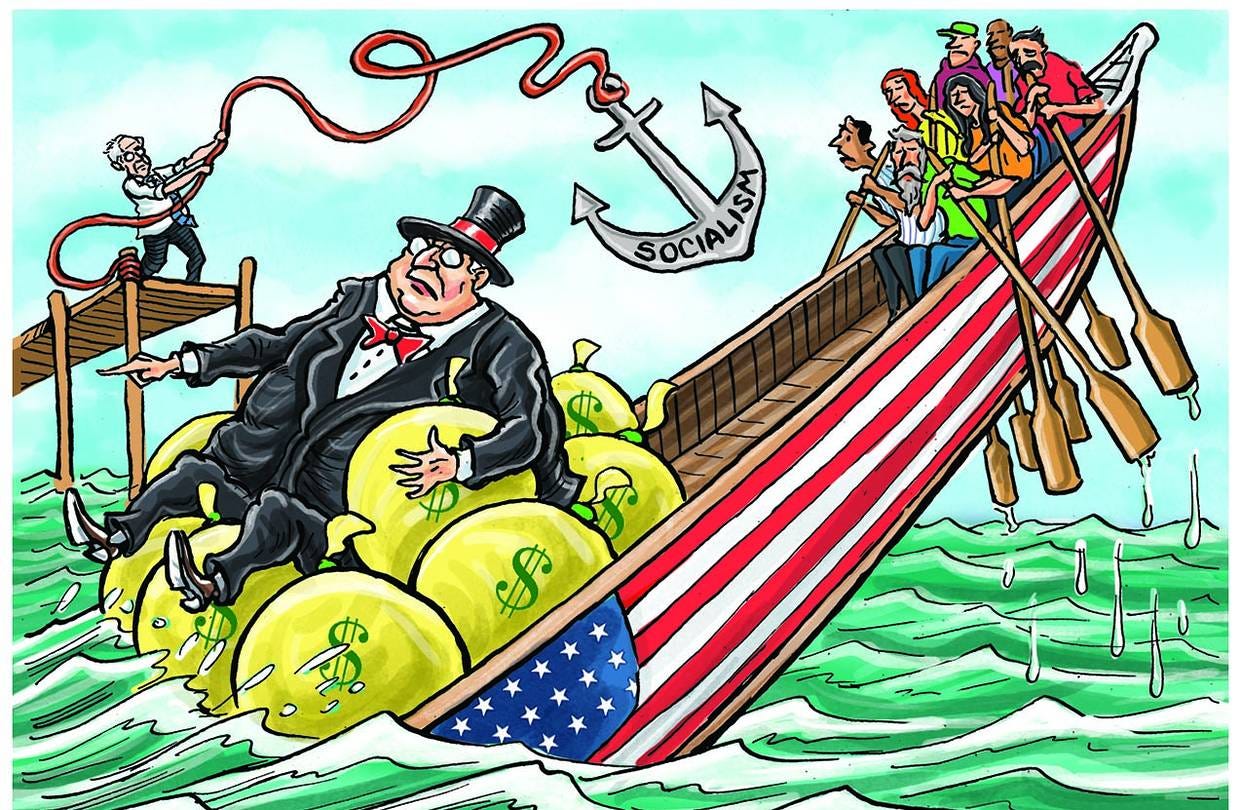
BUT THE CONVENTIONAL EXPLANATION for what has happened overlooks a critically important phenomenon — the increasing concentration of political power in a corporate and financial elite that has been able to alter the rules that run the economy.

And the conventional solution is in some ways beside the point, because it takes insufficient account of the corruption of government by these moneyed interests.

The debate over the merits of the “free market” versus an activist government has diverted attention from how the market has come to be organized differently from the way it was a half-century ago, why its current organization is failing to deliver the widely shared prosperity it delivered then, and what the basic rules of the market should be.

The diversion of attention is not accidental.

Many of the most vocal proponents of the “free market” — including executives of large corporations and their ubiquitous lawyers and lobbyists, denizens of Wall Street and their political lackeys, and numerous multimillionaires and billionaires — have for many years been actively reorganizing the market for their own benefit and would prefer these issues not be examined.  
MARKETS DEPEND for their very existence on rules governing property (what can be owned), monopoly (what degree of market power is permissible), contracts (what can be exchanged and under what terms), bankruptcy (what happens when purchasers can’t pay up), labor unions (how much power should workers have), and how all of this is enforced.

Such rules do not exist in nature. They must be decided upon, one way or another, by human beings.

These rules have been altered over the past four decades as large corporations, Wall Street, and wealthy individuals have gained increasing influence over the political institutions responsible for them.

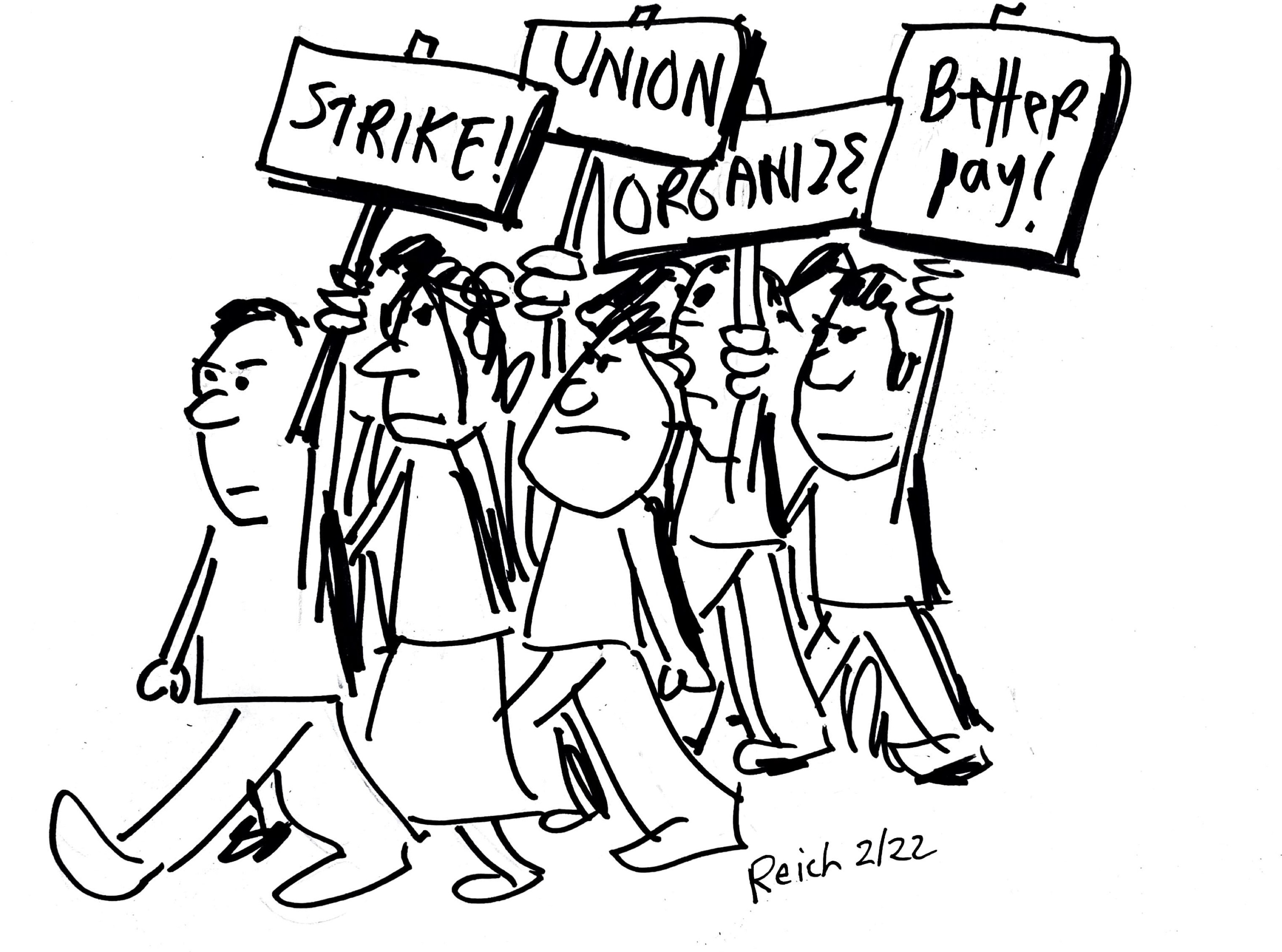
Simultaneously, centers of countervailing power that between the 1930s and 1980s enabled America’s middle and lower-middle classes to exert their own influence — labor unions, small businesses, family farms, and political parties anchored at the local and state levels — have withered.

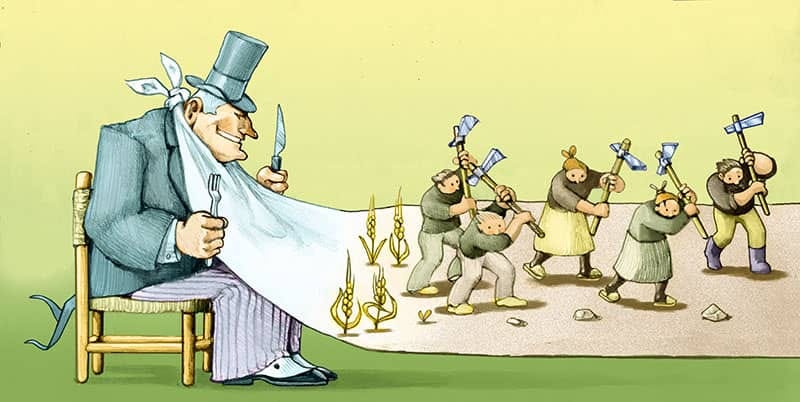
The consequence has been a market organized by those with great wealth for the purpose of further increasing their wealth.

This has resulted in ever-larger upward distributions inside the market, from the middle class and poor to a minority at the top. Because these distributions occur inside the market, they have largely escaped notice.

As we’ll see, the meritocratic claim that people are paid what they are “worth” in the market is a tautology that begs the questions of how the market is organized and whether that organization is morally and economically defensible.

In reality, income and wealth increasingly depend on who has the power to set the rules of the game.

CEOs of large corporations and Wall Street’s top traders and portfolio managers effectively determine their own pay, advancing market rules that enlarge corporate profits while using inside information to boost their fortunes.

Meanwhile, the pay of average workers has gone nowhere because they have lost countervailing economic power and political clout. The simultaneous rise of both the working poor and non-working rich offers further evidence that earnings no longer correlate with effort or with the common good.

All of this has brought us Donald Trump and America’s lurch toward fascism.

The underlying issue is not the size of government. It’s whom the government is for.

The remedy is for the vast majority to regain influence over how the market is organized. This will require a new countervailing power — allying the economic interests of the majority who have not shared the economy’s gains.

The battle pitting the “free market” against government is needlessly and perversely preventing such an alliance from forming.

The biggest political divide in America in years to come will be between, on the one side, the complex of CEOs of large corporations, top executives and traders at Wall Street banks, private equity and hedge-fund managers, and other moneyed interests who have fixed the economic and political game to their liking. And on the other side, the vast majority who have been left behind.

Some of the people who have been left behind are susceptible to the lies and bigotry of neofascists like Trump.

But the answer is not to give up on democracy.

To the contrary, the only way to reverse course is for the vast majority who now lack influence over the rules of the game to become organized and unified, in order to reestablish the countervailing power that was the key to widespread prosperity five decades ago.
IF WE DISPENSE with mythologies that have distracted us, we can make the system work for most of us rather than for only a relative handful.

History provides some direction as well as some comfort, especially in America, which has three times in our short history readapted the rules of the political economy to create a more inclusive society, while restraining the political power of wealthy minorities at the top.

In the 1830s, the Jacksonians targeted the special privileges of elites so the market system would better serve ordinary citizens.

In the late 19th and early 20th centuries, progressives enacted antitrust laws to break up the giant trusts, created independent commissions to regulate monopolies, and banned corporate political contributions.

In the 1930s, New Dealers limited the political power of large corporations and Wall Street while enlarging the countervailing power of labor unions, small businesses, and small investors.

The challenge is not just economic but political. Economics and politics cannot be separated.

It’s time for the Democratic Party and its leaders to give full-bodied voice to the forces — labor unions, small businesses, worker cooperatives, worker-owned businesses, family farmers, nonprofits, bottom-up politics, and all of us who are still committed to the common good — that together can countervail the overwhelming power of the big monied interests.

The issues we’ll discuss over the next eight weeks harken back to an earlier tradition of inquiry. The field used to be called “political economy” — the study of how a society’s laws and political institutions relate to a set of moral ideals. A fair distribution of income and wealth was a central topic.

In the eighteenth century, it was termed moral philosophy. (Adam Smith called himself a moral philosopher).

We must now return to the moral questions at the heart of politics and economics.

***

Next Friday, we’ll examine what I consider to be the biggest and most dangerous myth about capitalism, which has prevented Americans from understanding who is controlling it.

Thank you once again for joining me on this expedition. Please add your comments, take part in our discussion, and share with others.

Subscribers to this newsletter are keeping it going. If you are able, please consider a paid or gift subscription.

Share

Leave a comment

998 Likes
·
89 Restacks
998
653
89
Share
653 Comments
duncan cairncross
Dec 1Liked by Robert Reich

About the growth in the economy

I was an engineer - I spent decades improving productivity - in 10 years we doubled the output per man

Most of that was by working smarter - implementing good ideas

About half of the good ideas (along with some stinkers) came from the shop floor - the other half from the engineers

Not a single solitary good idea came from the executives in all the decades I was doing that

LIKE (211)
REPLY
SHARE
152 replies
Keith Olson
Writes Keith’s Substack
Dec 1

G.O.P. = Grand Oligarchy Party

When the Republicans get back in power they will

Mandate the following bills:

* Eliminating the Entitlement Programs, social security, Medicare, etc…..

* Repealing the Affordable Care Act (Obamacare)

* Promoting voter suppression

* Eliminating all gun laws

* Locking up political opponents

* Completely outlaw abortion

* Punishment for the woman who has one

* Eliminating LGBTQ

* Deport all undocumented immigrants

* Establishment of Christian Nationalism

* More tax cuts for the rich 🤑

LIKE (67)
REPLY
SHARE
26 replies
651 more comments...
Top
New
Community
Why I’m so short
Thoughts about heightism
JUL 11 • 
ROBERT REICH
3,097
1,553
The last adult in the room
Joe Biden is shrewd, careful, and calibrated. Almost everyone else on the stage is a wild child.
OCT 19 • 
ROBERT REICH
2,825
1,003
Henry Kissinger, 1923-2023. War criminal
Friends, Henry Kissinger has died, at the age of 100. When a former high government official as well known as Kissinger passes, the conventional…
NOV 30 • 
ROBERT REICH
2,891
872
Posted by THIRD PERSON at 01:47 No comments:
Email ThisBlogThis!Share to XShare to FacebookShare to Pinterest

Saturday, 2 December 2023

Improving the capability of the Indian state

Return to frontpage
HamberMenu
  1. HOME
  2. OPINION
  3. LEAD

Improving the capability of the Indian state 
PREMIUM

Perverse incentives created by public institutions and the skill gap among officials have eroded the ability to form and implement sound policies

December 02, 2023 12:16 am | Updated 08:16 am IST

RAM SINGH

COMMENTS

SHARE

BOOKMARKED

‘There is an extreme concentration of policymaking and implementation powers within departments’

‘There is an extreme concentration of policymaking and implementation powers within departments’ | Photo Credit: The Hindu

The Indian state is a paradox of too big and yet too small. Try setting up a business or building a house in an urban area, and you will quickly realise how the thicket of the licences, permits, clearances, and permissions can make life impossible. Even as an ordinary citizen, one can never be sure to be on the right side of the law and the circuitous regulations.

At the same time, the Weberian state in India is too small. In the G-20 group, the country has the smallest number of civil servants per capita. The public sector share in total employment in India (at 5.77%) is half the corresponding figures for Indonesia and China, and just about a third of that in the United Kingdom. With approximately 1,600 per million, the number of central government personnel in India pales in comparison to 7,500 in the United States. Similarly, the per capita number of doctors, teachers, town planners, police, judges, firefighters, inspectors for food and drugs, and regulators is the lowest even among countries at a similar stage of development.

ALSO READ
Listen to the people, not the numbers

The Indian state is relatively small on the other metrics, such as the tax-GDP ratio and public expenditure-GDP ratio. Be it public goods provisions, welfare payments, or the justice system, it is a story of scarcity rather than surplus. Due to an inadequate state capability, governments at the Centre and States end up outsourcing services that are better provided by the public sector, such as primary health.

Debating the role of the state

The proponents of inclusive development rightly pitch for a bigger role for the state — increased public spending on health, education, social security and a larger officialdom to go with it. Their detractors, on the other hand, cite innumerable policy failures to argue for a smaller state. The unwieldy state’s performance, they contend, is disappointing on all fronts be it students’ learning outcomes, child and maternal mortalities, farm and firm productivity, traffic conditions, and crime rates, among others.

Both sides to the debate are missing something fundamental. True, the Indian state is ‘people-thin’ but ‘process-thick’. The main problem, however, is the perverse incentives created by public institutions and the skill gap among officials. These factors have eroded the ability of the political executive and civil services to make and implement sound policies. A recent book, State Capability in India, by T. V. Somanathan and Gulzar Natarajan, two Indian Administrative Service (IAS) officers, suggests various measures to improve things without fiscal and political consequences.

ALSO READ
India needs public policy education

For instance, there is an extreme concentration of policymaking and implementation powers within departments. Experiences of countries such as Australia, Malaysia and the United Kingdom show that separating policymaking and implementation responsibilities expedites execution and encourages innovations, making the programmes better suited to local contexts. The Indian case in point is the National Highways Authority of India, which is tasked with executing national highway projects, while policy decisions are made at the ministry level. This arrangement has drastically reduced delays and cost overruns.

Latest News

  • 1 hour ago - Other StatesJharkhand puts hospitals on alert amid pneumonia outbreak in China
  • 1 hour ago - HealthIn 2022, India accounted for 66% of malaria cases in WHO South-East Asia Region: World Malaria Report
  • 1 hour ago - Other SportsR. Vaishali becomes India’s third female chess Grandmaster
  • 1 hour ago - IndiaVice President says retired judges keeping country's arbitral system in tight fist grip

Moreover, restrictions on the frontline personnel to decide on implementation-related issues foster a culture of mistrust and lack of accountability for poor implementation. The vicious cycle wherein poor delegation and a deficient state capability feed each other can be broken by delegating financial and administrative powers to the frontline functionaries, with clearly defined processes for using them.

ALSO READ
Modi government gives fresh push to lateral recruitment, decides to induct 17 private sector specialists

The technocratic gap

The top policymakers exhibit a lack of technocratic skills to govern an increasingly complex economy. In the absence of adequate capability to deal with economic, financial, contract and other technical matters, the Centre and the States hire consultancy firms. According to media reports, the central government paid over ₹500 crore in the last five years to outsource crucial tasks to the big five consultancy firms, i.e., PricewaterhouseCoopers, Deloitte, Ernst & Young, the KPMG and McKinsey.

An institutionalised and regular lateral entry at the mid and senior levels can help fill the civil services’ size and technocratic gap. Qualified officers in non-IAS services (such as the Indian Revenue, Economic and Statistical Services) should get a fair shot at high-level positions if they have the talent and the expertise required. Civil servants at different levels can be provided subject-specific training under Mission Karmayogi (National Programme for Civil Services Capacity Building).

ALSO READ
Propelling India’s development the right way

Similarly, there is a need to augment the strength of professional staff with market watchdogs, the Securities and Exchange Board of India, and the Reserve Bank of India (RBI). The first has just about 800 professionals, whereas its counterpart in the U.S., the U.S. Securities and Exchange Commission, has more than 4,500 experts to govern the corporates. Similarly, the professional staff strength of the RBI, less than 7,000, is tiny when compared to the US Federal Reserve which is assisted by 22,000 odd professionals.

Also read |National Centre for Good Governance expanding capacity to train higher number of civil servants from more countries

Yet another problem is the narrowly scoped audits by the Comptroller and Auditor General of India. It encourages the finance and administrative divisions in government to focus on compliance with rules rather than policy objectives. The tendency of the other oversight agencies, i.e., the Central Vigilance Commission, the Central Bureau of Investigation and courts to use hindsight information without appreciating the context has made the bureaucrats averse to exercising discretion in policy matters. Officials prefer to cancel big contracts even when granting extensions would be better. The net outcome is delayed procurement of goods and services and unnecessary contractual disputes. Appealing against arbitration and court awards have become the default mode by officials, making the government the biggest litigator. To fix this, the oversight agencies must be sensitised to appreciate the context of policy decisions. They should factor in the costs associated with the actual decisions as well as their alternatives.

The political will is required to address other issues, such as the appointment of retired officers to regulatory bodies and tribunals. The beneficiaries of such appointments enjoy hefty salaries without compromising the pensionary benefits from past services. This makes civil servants susceptible to political manipulation and influences their in-service decisions. The problem can be fixed by increasing the retirement age to say 65, and making an absolute upper limit for all appointments.

ALSO READ
National Training Conclave: PM underlines importance of capacity building, ending silos

Public versus private sector

The political economy of the public sector also undermines its efficacy. It is well known that performance-linked pay and incentive schemes such as bonuses, which work well in the private sector, are not very effective in the public sector. The public sector must attract intrinsically motivated individuals to contribute to the social good. Paradoxically, the relatively high salaries in the public sector reduce its effectiveness. Because of job security and better working conditions, the risk and skill-adjusted pay in the public sector should be lower than what it is in the private sector. In India, however, the opposite is true due to the substantial salary hikes by the 6th Pay and the 7th Pay Commissions. Except at the top, for most of the skill spectrum, public sector salaries are much higher than private wages. It breeds corruption in appointments as it makes government jobs very lucrative for all, socially driven or not.

Also read | Must use ‘last-mile’, ‘good governance’ approach to reach out to people in remotest corners, minorities: PM Modi

The solution lies in moderate pay raises by the future Pay Commission and a reduction in the upper age limit for government jobs. Moreover, high economic growth that throws up many lucrative jobs in the private sector will make government jobs less appealing for those who are money minded. Put together, these measures can reduce corruption and increase the chances of socially-driven individuals joining the government.

Ram Singh is Director, Delhi School of Economics and Director, Delhi School of Public Policy and Governance

COMMENTS

SHARE

Related Topics

government departments / G20 / India / Indonesia / China / United Kingdom / medical staff / teachers / police / judge / development / welfare / justice and rights / health / social security / Australia / Malaysia / consultancy service / Reserve Bank of India / USA / investigation / civil and public service

Recommended

Maratha quota demand | Maharashtra’s winter of caste discontent

Maratha quota demand | Maharashtra’s winter of caste discontent

The process of Myanmar’s actual political unification has begun

UAE announces $30 billion fund to catalyse private sector climate investments

More than 100 Rohingya refugees land in Indonesia: officials

Top News Today

The Afghan Embassy in New Delhi. File
INDIA

Hope for reviving Afghan embassy in India, after Afghan diplomats appear divided on closing the mission

KALLOL BHATTACHERJEE
Oded Joseph, the Israeli Foreign Ministry’s top diplomat for the Mideast, attends an interview at the COP28 U.N. Climate Summit in Dubai on December 1, 2023.
WORLD

Israel pavilion at COP venue in Dubai seeks to highlight ‘terrorism’

JACOB P KOSHY
PM Modi emplanes for Delhi after attending the COP28 summit in Dubai, UAE on December 01, 2023. Photo: Twitter/@PMOIndia
INDIA

PM Modi leaves for India after attending World Climate Action Summit

He returns to India after completing a very successful, productive and action-oriented participation, Foreign Secretary Vinay Kwatra said
PTI
DELHI

Political parties make a beeline for members of the tunnel rescue team

ALISHA DUTTA
ENVIRONMENT

Above-normal temperatures likely in most parts of country in December: IMD

PTI
This picture taken and released by Vietnam News Agency (VNA) on December 1, 2023 shows China’s Foreign Minister Wang Yi (L) shaking hands with Vietnam’s Deputy Prime Minister Tran Luu Quang in Hanoi.
WORLD

China, Vietnam weigh rail link through rare earths heartland

REUTERS
WORLD

UAE announces $30 billion fund to catalyse private sector climate investments

JACOB KOSHY
WORLD

Israel knew about Hamas attack over a year in advance: report

AP
SEE MORE
Return to frontpage
Google PlayApple Store
  • The Hindu
    • About Us
    •  
    • Code of Editorial Values
    •  
    • News Archive
    •  
    • Sitemap
    •  
    • Print Subscription
    •  
    • Digital Subscription
    •  
    • Subscribe to Newsletters
    •  
    • Rss Feeds
    •  
    • Readers Editor-Terms of Reference
    •  
    • Authors & Contributors
  • Contact us
    • Contact Us
    •  
    • Social Media
    •  
    • Advertise With Us
  • Group News Sites
    • Business Line
    •  
    • BL on Campus
    •  
    • Sportstar
    •  
    • Frontline
    •  
    • இந்து தமிழ் திசை
    •  
    • The Hindu Centre
    •  
    • Young World Club
    •  
    • The Hindu ePaper
    •  
    • Business Line ePaper
    •  
    • Crossword + Free Games
  • Other Products
    • RoofandFloor
    •  
    • STEP
    •  
    • Images
    •  
    • Classifieds - Digital
    •  
    • Classifieds - Print
    •  
    • Bookstore & Special Publications
  • Popular Sections
    • Elections
    •  
    • Israel Hamas War Live Updates
    •  
    • Israeli–Palestinian conflict 2023
    •  
    • Latest News
    •  
    • National News
    •  
    • International News
    •  
    • Videos
    •  
    • Life & Style
    •  
    • Food
    •  
    • Podcast
    •  
    • Showcase
  • Opinion
    • Editorial
    •  
    • Columns
    •  
    • Comment
    •  
    • Cartoon
    •  
    • Letters
    •  
    • Interview
    •  
    • Lead
  • Business
    • Agri-Business
    •  
    • Industry
    •  
    • Economy
    •  
    • Markets
    •  
    • Budget
  • Sport
    • Cricket
    •  
    • Football
    •  
    • Hockey
    •  
    • Tennis
    •  
    • Athletics
    •  
    • Motorsport
    •  
    • Races
    •  
    • Other Sports
  • Sci-Tech
    • Science
    •  
    • Technology
    •  
    • Health
    •  
    • Agriculture
    •  
    • Environment
    •  
    • Gadgets
    •  
    • Internet
  • States
    • Andhra Pradesh
    •  
    • Karnataka
    •  
    • Kerala
    •  
    • Tamil Nadu
    •  
    • Telangana
    •  
    • Other States
  • Cities
    • Bengaluru
    •  
    • Chennai
    •  
    • Coimbatore
    •  
    • Delhi
    •  
    • Hyderabad
    •  
    • Kochi
    •  
    • Kolkata
    •  
    • Kozhikode
    •  
    • Madurai
    •  
    • Mangaluru
    •  
    • Mumbai
    •  
    • Puducherry
    •  
    • Thiruvananthapuram
    •  
    • Tiruchirapalli
    •  
    • Vijayawada
    •  
    • Visakhapatnam
Trending on thehindu.com
  • ‘Animal’ movie review: Ranbir Kapoor suffers in Sandeep Reddy Vanga’s twisted paean to masculinity 
  • Chennai, nearby districts to get heavy rain from December 2 to 4 
  • COP28 | Rising ambitions on climate action must see matching progress on climate finance: PM Modi 
  • 48 schools in and around Bengaluru get threat email; children sent back home 
  • GDP surges 7.6% in Q2, goes past RBI forecast 
Trending on our Group sites
  • Indian tourists flock to visa-free destinations: Malaysia, Thailand, Sri Lanka see 100% spike in travel demand 
  • Hyderabad drags voting percentage in Telangana polls to 64% 
  • Henry Kissinger: Farewell to arms 
  • How BJP’s yoga misadventure in Maldives paved the way for China to assert its dominance 
  • IPL auction 2024: Full list of squads, players after retention day 
  • Facebook
  • Twitter
  • Instagram
  • Linkedin
  • Youtube
  • Spotify
  • Telegram
  • TERMS OF USE
  •  
  • PRIVACY POLICY
  •  
Copyright© 2023, THG PUBLISHING PVT LTD. or its affiliated companies. All rights reserved.

BACK TO TOPBack to Top

Posted by THIRD PERSON at 01:49 No comments:
Email ThisBlogThis!Share to XShare to FacebookShare to Pinterest
Newer Posts Older Posts Home
Subscribe to: Comments (Atom)

Blog Archive

  • ▼  2025 (8)
    • ▼  July (1)
      •  How do you speak of labour, or ecological justice...
    • ►  May (1)
    • ►  April (1)
    • ►  February (1)
    • ►  January (4)
  • ►  2024 (52)
    • ►  December (7)
    • ►  November (7)
    • ►  October (16)
    • ►  September (5)
    • ►  August (7)
    • ►  May (1)
    • ►  April (7)
    • ►  February (2)
  • ►  2023 (52)
    • ►  December (15)
    • ►  November (9)
    • ►  October (23)
    • ►  September (4)
    • ►  August (1)
  • ►  2022 (26)
    • ►  December (1)
    • ►  October (1)
    • ►  September (5)
    • ►  August (1)
    • ►  July (3)
    • ►  June (2)
    • ►  May (1)
    • ►  April (11)
    • ►  March (1)

About Me

My photo
THIRD PERSON
A man having mission to improve the quality of human resources.
View my complete profile
Watermark theme. Powered by Blogger.